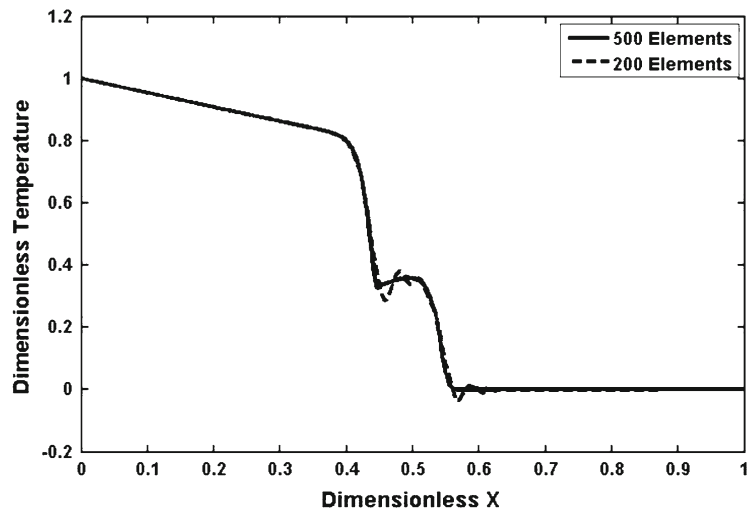
This paper presents a direct finite element approach for analyzing coupled thermoelasticity in layered media under thermal shock, examining how thermoelastic waves reflect and transmit at material interfaces. The analysis compares classical and generalized theories (Lord-Shulman, Green-Lindsay, Green-Naghdi) and reveals that wave distributions in multilayered structures differ dramatically from single-layer cases. This convergence study shows a critical finding: 500 elements yield minimum numerical noise, while 200 elements produce spurious oscillations near the wave front. The method successfully captures reflected and transmitted wave components at interfaces, enabling analysis of layered composites under thermal or mechanical impact loads.
Abstract
The behavior of thermoelastic waves at the interface of layered medium and distributions of these waves through the domain are examined by applying the direct finite element method to obtain the field variables directly within the spatial and temporal domains. The analysis is performed in a one-dimensional domain with two different layers to provide a means to follow the behavior of the reflected thermoelastic waves at the interface. It appears that the distributions of thermoelastic waves in an isotropic slab with one layer are significantly different from those in multilayered slabs. For instance, the negative displacement waves, several stresses with positive or negative signs and temperature distributions produced in the multilayered domains, are quite different from those in a single layer. This method may be generalized to simulate the propagation of thermoelastic waves in various multilayered regions and analyze the behavior of the layered composite structures under the mechanical or thermal impact loads.
Keywords: thermoelastic waves, layered media, finite element method, coupled thermoelasticity, wave propagation, composite structures
Citation
Please cite this work as:
S. K. Hosseini Zad, A. Komeili, M. R. Eslami, S. Fariborz. "Classical and generalized coupled thermoelasticity analysis in one-dimensional layered media". Archive of Applied Mechanics (2012). https://doi.org/10.1007/s00419-011-0555-7
Or use the BibTeX citation:
@article{Hosseini Zad2012,
author = {Hosseini Zad, S. K. and Komeili, A. and Eslami, M. R. and Fariborz, S.},
title = {Classical and generalized coupled thermoelasticity analysis in one-dimensional layered media},
journal = {Archive of Applied Mechanics},
year = {2012},
month = {02},
day = {01},
volume = {82},
number = {2},
pages = {267--282},
issn = {1432-0681},
doi = {10.1007/s00419-011-0555-7},
url = {https://doi.org/10.1007/s00419-011-0555-7}
}