Abstract
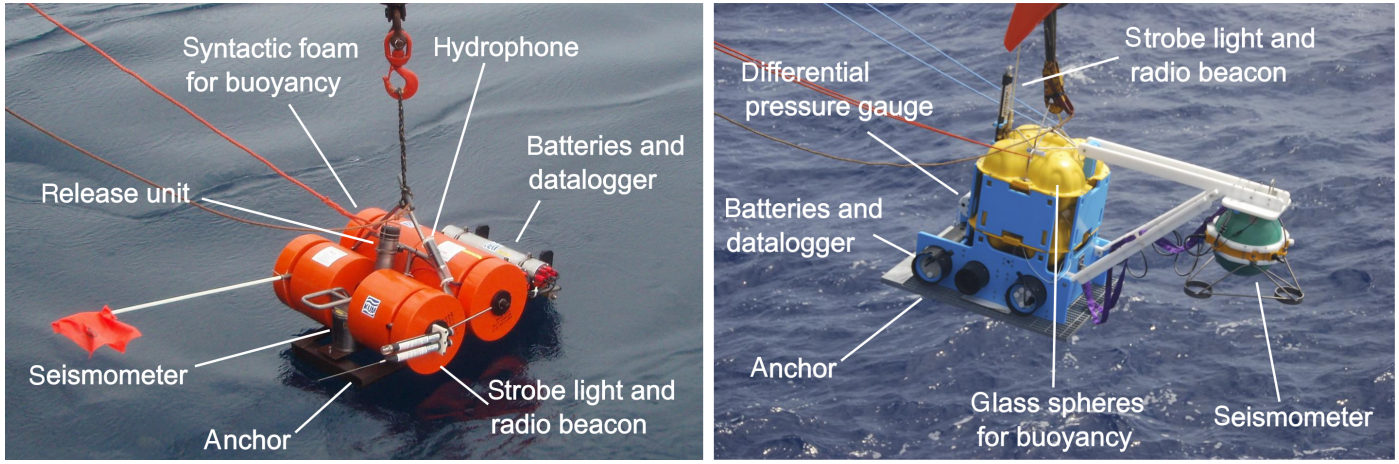
RHUM-RUM is a German-French seismological experiment based on the sea floor surrounding the island of La Réunion, western Indian Ocean (Barruol and Sigloch, 2013). Its primary objective is to clarify the presence or absence of a mantle plume beneath the Reunion volcanic hotspot. RHUM-RUM’s central component is a 13-month deployment (October 2012 to November 2013) of 57 broadband ocean bottom seismometers (OBS) and hydrophones over an area of 2000 × 2000 km² surrounding the hotspot. The array contained 48 wideband OBS from the German DEPAS pool and 9 broadband OBS from the French INSU pool. It is the largest deployment of DEPAS and INSU OBS so far, and the first joint experiment.
This article reviews network performance and data quality: of the 57 stations, 46 and 53 yielded good seismometer and hydrophone recordings, respectively. The 19 751 total deployment days yielded 18 735 days of hydrophone recordings and 15 941 days of seismometer recordings, which are 94 and 80 % of the theoretically possible yields.
The INSU seismic sensors stand away from their OBS frames, whereas the DEPAS sensors are integrated into their frames. At long periods (> 10 s), the DEPAS seismometers are affected by significantly stronger noise than the INSU seismometers. On the horizontal components, this can be explained by tilting of the frame and buoy assemblage, e.g. through the action of ocean-bottom currents, but in addition the DEPAS intruments are affected by significant self-noise at long periods, including on the vertical channels. By comparison, the INSU instruments are much quieter at periods > 30 s and hence better suited for long-period signals studies.
The trade-off of the instrument design is that the integrated DEPAS setup is easier to deploy and recover, especially when large numbers of stations are involved. Additionally, the wideband sensor has only half the power consumption of the broadband INSU seismometers. For the first time, this article publishes response information of the DEPAS instruments, which is necessary for any project where true ground displacement is of interest.
Keywords: ocean bottom seismometers, RHUM-RUM, La Réunion hotspot, mantle plume, seismic network, instrumentation