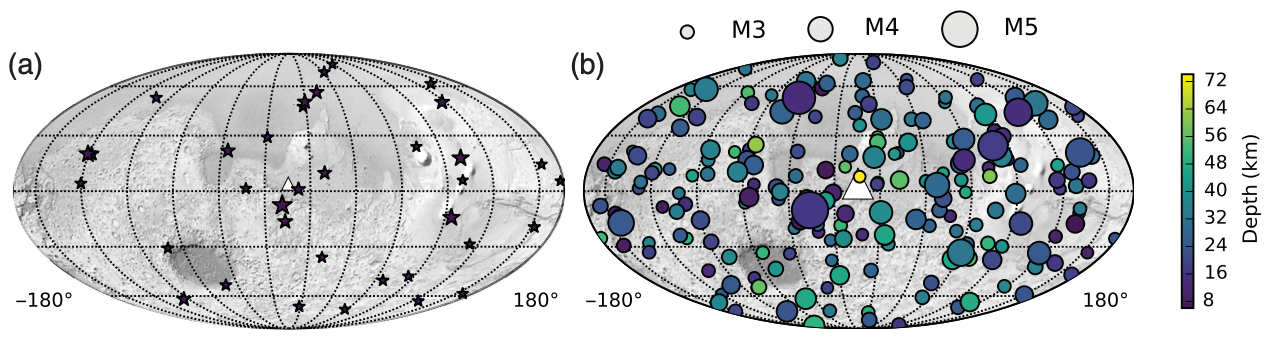
Building a seismicity catalog from a single seismometer is challenging on Earth but becomes far more difficult on Mars, where noise characteristics, seismic velocities, and source types are poorly constrained. Before InSight's December 2018 landing, the marsquake service prepared the community with a blind test: 84 teams from 20 countries attempted to detect and characterize seismicity in one year of synthetic Martian data. This figure shows the true catalog of impacts and marsquakes (randomly distributed, centered on the landing site marked by white triangle), but only a fraction were detectable above Mars's noise level. Eleven teams submitted results combining established techniques with novel approaches tailored to single-station planetary seismology. The exercise generated over 100 pages of documentation, revealing the diversity of strategies needed when you cannot triangulate event locations from multiple stations and must instead rely on analyzing individual waveform characteristics, surface wave dispersion, and polarization.
Abstract
In December 2018, the National Aeronautics and Space Administration (NASA) Interior exploration using Seismic Investigations, Geodesy and Heat Transport (InSight) mission deployed a seismometer on the surface of Mars. In preparation for the data analysis, in July 2017, the marsquake service initiated a blind test in which participants were asked to detect and characterize seismicity embedded in a one Earth year long synthetic data set of continuous waveforms. Synthetic data were computed for a single station, mimicking the streams that will be available from InSight as well as the expected tectonic and impact seismicity, and noise conditions on Mars (Clinton et al., 2017). In total, 84 teams from 20 countries registered for the blind test and 11 of them submitted their results in early 2018. The collection of documentations, methods, ideas, and codes submitted by the participants exceeds 100 pages. The teams proposed well established as well as novel methods to tackle the challenging target of building a global seismicity catalog using a single station. This article summarizes the performance of the teams and highlights the most successful contributions.
Keywords: InSight mission, Mars seismology, marsquakes, blind test, single-station seismology, planetary seismology, seismic detection
Citation
Please cite this work as:
Martin van Driel, Savas Ceylan, John Francis Clinton, Domenico Giardini, [...], Kasra Hosseini, [...], and 54 others. "Preparing for InSight: Evaluation of the Blind Test for Martian Seismicity". Seismological Research Letters (2019). https://doi.org/10.1785/0220180379
Or use the BibTeX citation:
@article{10.1785/0220180379,
author = {van Driel, Martin and Ceylan, Savas and Clinton, John Francis and Giardini, Domenico and [...] and Hosseini, Kasra and [...] and 54 others},
title = {Preparing for InSight: Evaluation of the Blind Test for Martian Seismicity},
journal = {Seismological Research Letters},
volume = {90},
number = {4},
pages = {1518-1534},
year = {2019},
month = {06},
issn = {0895-0695},
doi = {10.1785/0220180379},
url = {https://doi.org/10.1785/0220180379}
}