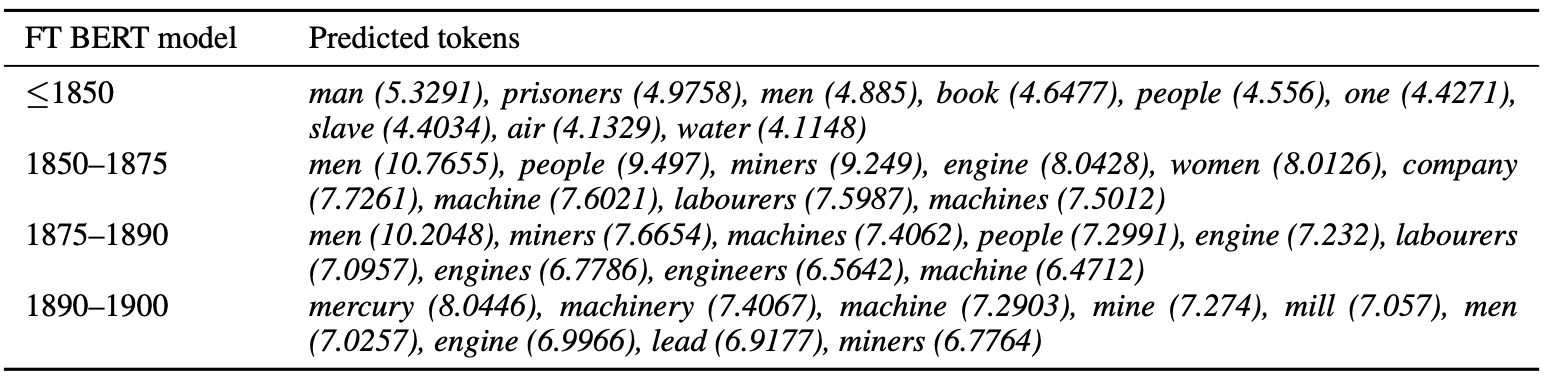
During the Industrial Revolution, something subtle yet profound happened to English: machines began to "live" in the language. Writers increasingly attributed animate qualities to inanimate objects, describing machines that could work, fail, or behave. This paper tackles the challenge of detecting such atypical animacy using BERT contextualized embeddings trained on nineteenth-century English books. The table demonstrates a striking pattern: when different time-period language models predict tokens for "They were told that the [MASK] stopped working," more recent models increasingly suggest machine-related words (engine, machinery) rather than human-related ones. This fully unsupervised approach captures the gradual linguistic shift as machines became conceptualized as active agents rather than passive tools, providing fine-grained evidence of how technological change reshapes the way we speak.
Abstract
This paper proposes a new approach to animacy detection, the task of determining whether an entity is represented as animate in a text. In particular, this work is focused on atypical animacy and examines the scenario in which typically inanimate objects, specifically machines, are given animate attributes. To address it, we have created the first dataset for atypical animacy detection, based on nineteenth-century sentences in English, with machines represented as either animate or inanimate. Our method builds on recent innovations in language modeling, specifically BERT contextualized word embeddings, to better capture fine-grained contextual properties of words. We present a fully unsupervised pipeline, which can be easily adapted to different contexts, and report its performance on an established animacy dataset and our newly introduced resource. We show that our method provides a substantially more accurate characterization of atypical animacy, especially when applied to highly complex forms of language use.
Keywords: animacy detection, atypical animacy, BERT, historical text, nineteenth-century English, digital humanities, language models
Citation
Please cite this work as:
Mariona Coll Ardanuy, Federico Nanni, Kaspar Beelen, Kasra Hosseini, Ruth Ahnert, Jon Lawrence, Katherine McDonough, Giorgia Tolfo, Daniel CS Wilson, Barbara McGillivray. "Living Machines: A study of atypical animacy". Proceedings of the 28th International Conference on Computational Linguistics (COLING) (2020). https://aclanthology.org/2020.coling-main.400/
Or use the BibTeX citation:
@inproceedings{coll-ardanuy-etal-2020-living,
title = "Living Machines: A study of atypical animacy",
author = "Coll Ardanuy, Mariona and
Nanni, Federico and
Beelen, Kaspar and
Hosseini, Kasra and
Ahnert, Ruth and
Lawrence, Jon and
McDonough, Katherine and
Tolfo, Giorgia and
Wilson, Daniel CS and
McGillivray, Barbara",
editor = "Scott, Donia and
Bel, Nuria and
Zong, Chengqing",
booktitle = "Proceedings of the 28th International Conference on Computational Linguistics",
month = dec,
year = "2020",
address = "Barcelona, Spain (Online)",
publisher = "International Committee on Computational Linguistics",
url = "https://aclanthology.org/2020.coling-main.400/",
doi = "10.18653/v1/2020.coling-main.400",
pages = "4534--4545"
}