Abstract
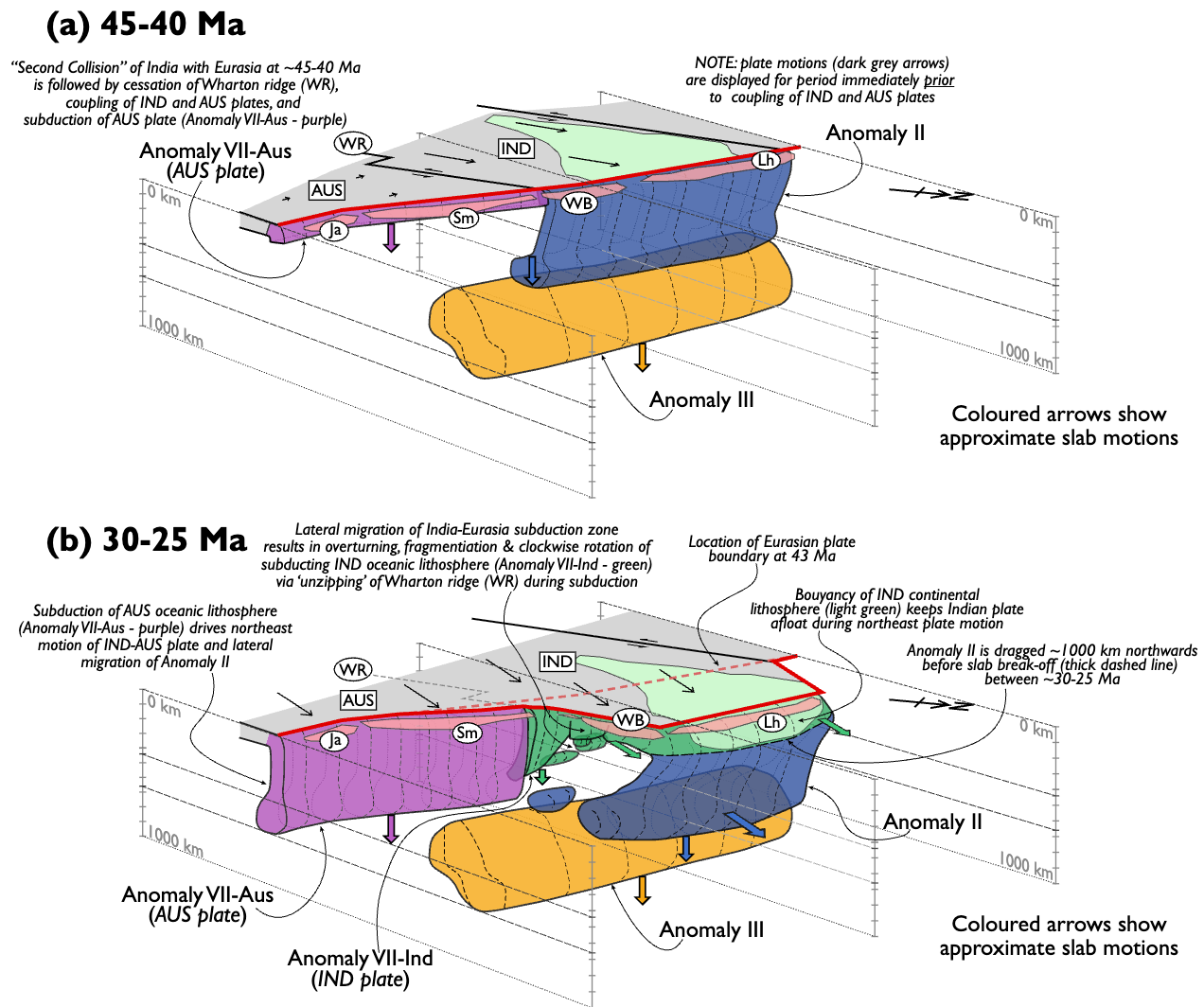
Distributions of slabs within Earth’s mantle are increasingly used to reconstruct past subduction zones, based on first-order assumptions that slabs sink vertically after slab break-off, and thus delineate paleo-trench locations. Non-vertical slab motions, which occur prior to break-off, represent a potentially significant source of error for slab-based plate reconstructions, but are poorly understood. We constrain lateral migration of the Indian slab and overlying India-Asia collision zone by comparing tomographically imaged mantle structure with plate-kinematic constraints. Following coupling of the Indian and Australian plates at the onset of collision, ∼1,000 km lateral migration of the Indian slab was driven by vertical subduction of the Australian slab. The sinking behaviors of individual slabs do not evolve in isolation, but instead influence, or are influenced by, other slabs in the same plate network. Hence, lateral slab migrations may be determined by interpreting the sinking behavior of slabs collectively, and with respect to plate kinematics.
Plain Language Summary
To understand the links between plate tectonics and mantle processes, researchers must determine how tectonic plates have moved with respect the evolving mantle through geological time. To overcome this problem, recent studies use the locations of subducted slabs in the deep mantle to reconstruct plate motions, based on the hypothesis that slabs sink vertically through the mantle, and therefore mark the surface locations of past subduction zones. Here, we test slab sinking hypotheses, and their use in plate reconstruction modeling, by investigating the sinking kinematics of the subducting Indian and Australian slabs during the India-Asia collision. Our analysis indicates that since onset of collision at ∼45–40 Ma, the Indian slab migrated laterally, ∼1,000 km northwards through the mantle, driven by subduction of the neighboring Australian slab. We arrive at this new interpretation because we interpret Indian and Australian slab kinematics collectively, and with respect to India-Australia plate motions. Our study shows that the sinking behavior of one slab can influence that of another slab in the same network. Slab-based plate reconstructions should therefore interpret slabs of the same network collectively, and with respect to plate motions, in order to constrain non-vertical slab motions and avoid potentially significant plate reconstruction errors.
Keywords: plate tectonics, subduction, tomography, India-Asia collision, Tethys, mantle, slab migration