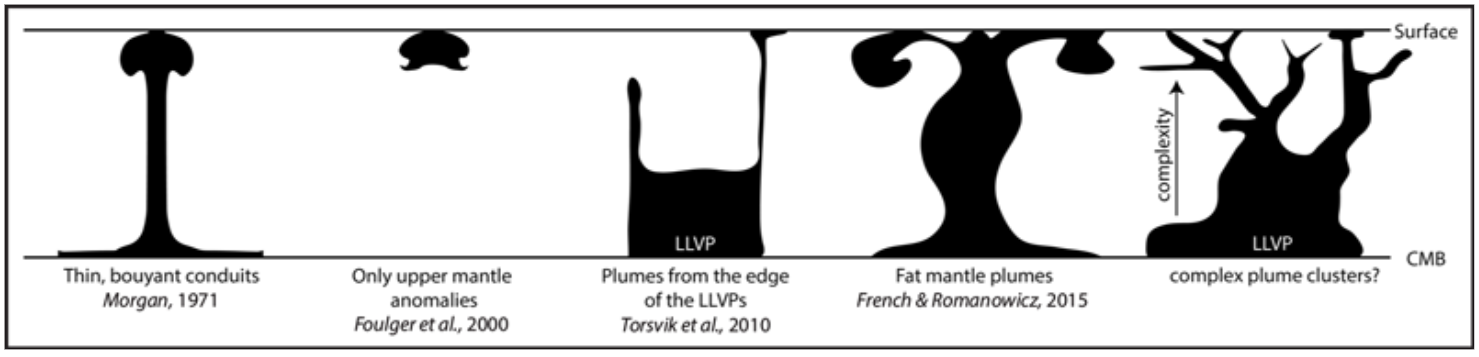
Since 1971, mantle plumes have been envisioned as thin, vertical pipes of hot rock rising from the core-mantle boundary to feed volcanic hotspots like Réunion and Kerguelen. But imaging these conduits has proved frustratingly difficult because most lie beneath uninstrumented oceans. Using seismic waves that extensively sample the deepest mantle, we reveal that Indo-African upwellings are not simple vertical pipes but rather arranged in a tree-like structure: a central trunk below approximately 1,500 km depth with three tilting branches extending outward and upward toward different hotspots. This figure traces the evolution of plume geometry concepts, from Morgan's original thin conduits to our new tree-like model. We propose that each branch represents an alignment of rising blobs that detached in staggered sequence from a low-velocity corridor at the core-mantle boundary, like beads on a tilted string, each spawning a classical plume-head and tail upon reaching the viscosity contrast between lower and upper mantle.
Abstract
Mantle plumes were conceived as thin, vertical conduits in which buoyant, hot rock from the lowermost mantle rises to Earth’s surface, manifesting as hotspot-type volcanism far from plate boundaries. Spatially correlated with hotspots are two vast provinces of slow seismic wave propagation in the lowermost mantle, probably representing the heat reservoirs that feed plumes. Imaging plume conduits has proved difficult because most are located beneath the non-instrumented oceans, and they may be thin. Here we combine new seismological datasets to resolve mantle upwelling across all depths and length scales, centred on Africa and the Indian and Southern oceans. Using seismic waves that sample the deepest mantle extensively, we show that mantle upwellings are arranged in a tree-like structure. From a central, compact trunk below ~1,500 km depth, three branches tilt outwards and up towards various Indo-Austral hotspots. We propose that each tilting branch represents an alignment of vertically rising blobs or proto-plumes, which detached in a linear staggered sequence from their underlying low-velocity corridor at the core–mantle boundary. Once a blob reaches the viscosity discontinuity between lower and upper mantle, it spawns a ‘classical’ plume-head/plume-tail sequence.
Keywords: mantle plumes, seismic tomography, hotspots, mantle upwelling, Indo-African plumes, deep mantle structure
Citation
Please cite this work as:
Maria Tsekhmistrenko, Karin Sigloch, Kasra Hosseini, Guilhem Barruol. "A tree of Indo-African mantle plumes imaged by seismic tomography". Nature Geoscience (2021). https://doi.org/10.1038/s41561-021-00762-9
Or use the BibTeX citation:
@article{Tsekhmistrenko2021,
author = {Tsekhmistrenko, Maria and Sigloch, Karin and Hosseini, Kasra and Barruol, Guilhem},
title = {A tree of Indo-African mantle plumes imaged by seismic tomography},
journal = {Nature Geoscience},
volume = {14},
number = {8},
pages = {612--619},
year = {2021},
month = {08},
day = {01},
abstract = {Mantle plumes were conceived as thin, vertical conduits in which buoyant, hot rock from the lowermost mantle rises to Earth's surface, manifesting as hotspot-type volcanism far from plate boundaries. Spatially correlated with hotspots are two vast provinces of slow seismic wave propagation in the lowermost mantle, probably representing the heat reservoirs that feed plumes. Imaging plume conduits has proved difficult because most are located beneath the non-instrumented oceans, and they may be thin. Here we combine new seismological datasets to resolve mantle upwelling across all depths and length scales, centred on Africa and the Indian and Southern oceans. Using seismic waves that sample the deepest mantle extensively, we show that mantle upwellings are arranged in a tree-like structure. From a central, compact trunk below ~1,500 km depth, three branches tilt outwards and up towards various Indo-Austral hotspots. We propose that each tilting branch represents an alignment of vertically rising blobs or proto-plumes, which detached in a linear staggered sequence from their underlying low-velocity corridor at the core–mantle boundary. Once a blob reaches the viscosity discontinuity between lower and upper mantle, it spawns a 'classical' plume-head/plume-tail sequence.},
issn = {1752-0908},
doi = {10.1038/s41561-021-00762-9},
url = {https://doi.org/10.1038/s41561-021-00762-9}
}