Abstract
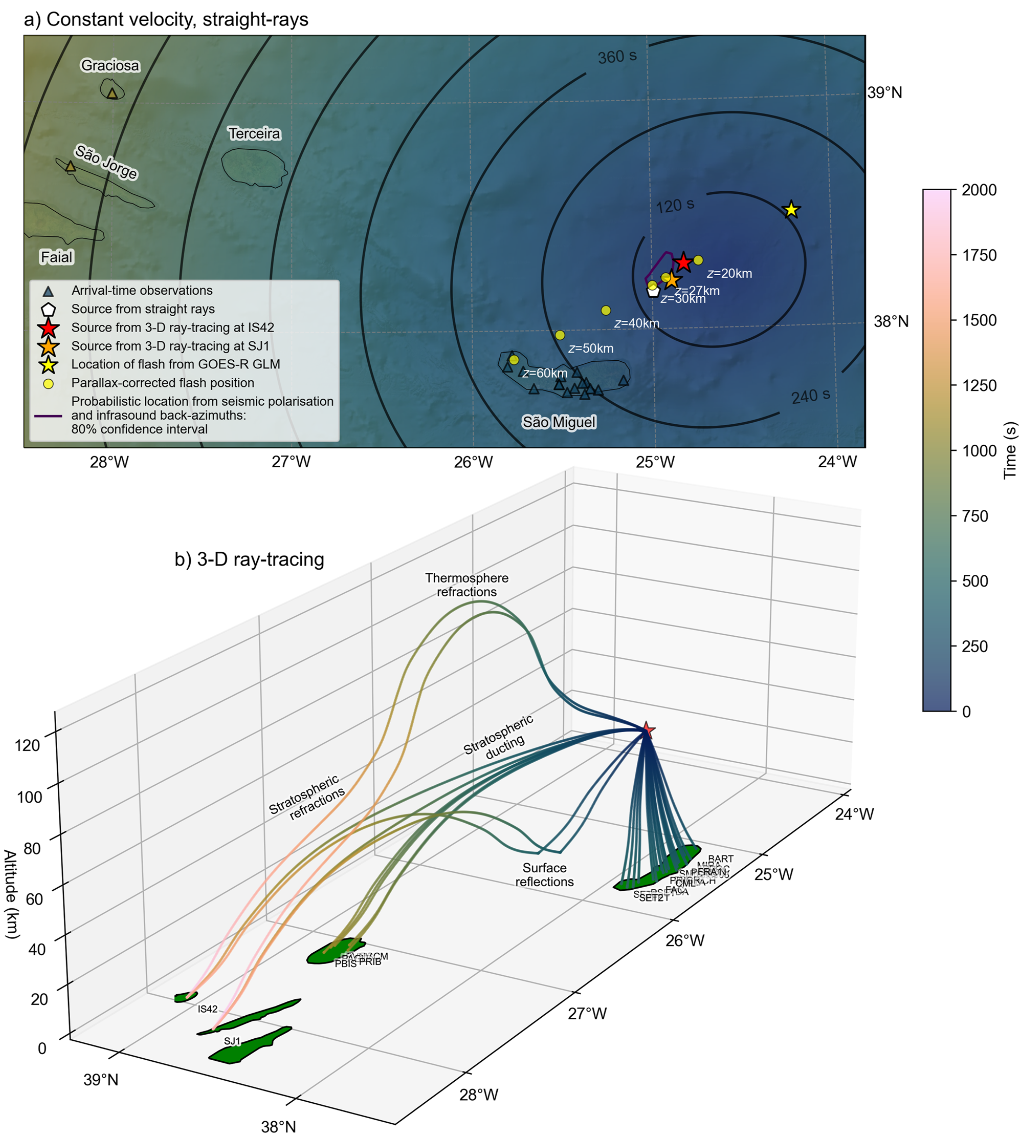
Small meteoroids that enter Earth’s atmosphere often go unnoticed because their detection and characterization rely on human observations, introducing observational biases in space and time. Acoustic shockwaves from meteoroid ablation convert to infrasound and seismic energy, enabling fireball detection using seismoacoustic methods. We analyzed an unreported fireball in 2022 near the Azores, recorded by 26 seismometers and two infrasound arrays. Through polarization analyses, array methods, and 3-D ray-tracing, we determined that the terminal blast occurred at 40 km altitude, approximately 60 km NE of São Miguel Island. This location matches an unidentified flash captured by a lightning detector aboard the GOES-16 satellite. The estimated kinetic energy is approximately 10⁻³ kT TNT equivalent, suggesting a 10⁻¹ m object diameter, thousands of which enter the atmosphere annually. Our results demonstrate how geophysical methods, in tandem with satellite data, can significantly improve the observational completeness of meteoroids, advancing our understanding of their sources and entry processes.
Plain Language Summary
Every year, hundreds to thousands of small near-Earth objects, known as meteoroids, enter Earth’s atmosphere. Their hypersonic entry speed and break-up can generate flashes known as fireballs and associated shockwaves that can reach the ground. However, it is only the largest objects breaking up above populated areas that we typically see or hear, or that are captured by dedicated camera systems. Many of the smaller meteoroids go unnoticed. This observational bias limits our understanding of these objects and how they enter Earth’s atmosphere. Here, we report on a fireball that broke up over the Northern Atlantic Ocean in June 2022 and was recorded on a network of seismometers that record sensitive ground motion and infrasound sensors that “hear” low-frequency sound waves. Our analyses of these data show a small (40 cm diameter) meteoroid exploded at around 40 km altitude and 60 km northeast of São Miguel Island. Crucially, a flash recorded by a lightning mapper aboard a weather satellite provides us with the exact time of the explosion. To the best of our knowledge, this event is one of few documented cases of a fireball detected solely by geophysical means without relying on initial reports from human observers or photographic/video evidence.
Keywords: meteoroid, fireball, infrasound, seismoacoustic, geostationary lightning mapper, near-Earth object, Azores